


Mon - Sat: 9:00 AM - 6:00 PM
Solutions
California CARS Act Compliance for Car Dealers
Every rule in plain English, and the exact LeadLocate tools that put each one on paper for your store, deal after deal.
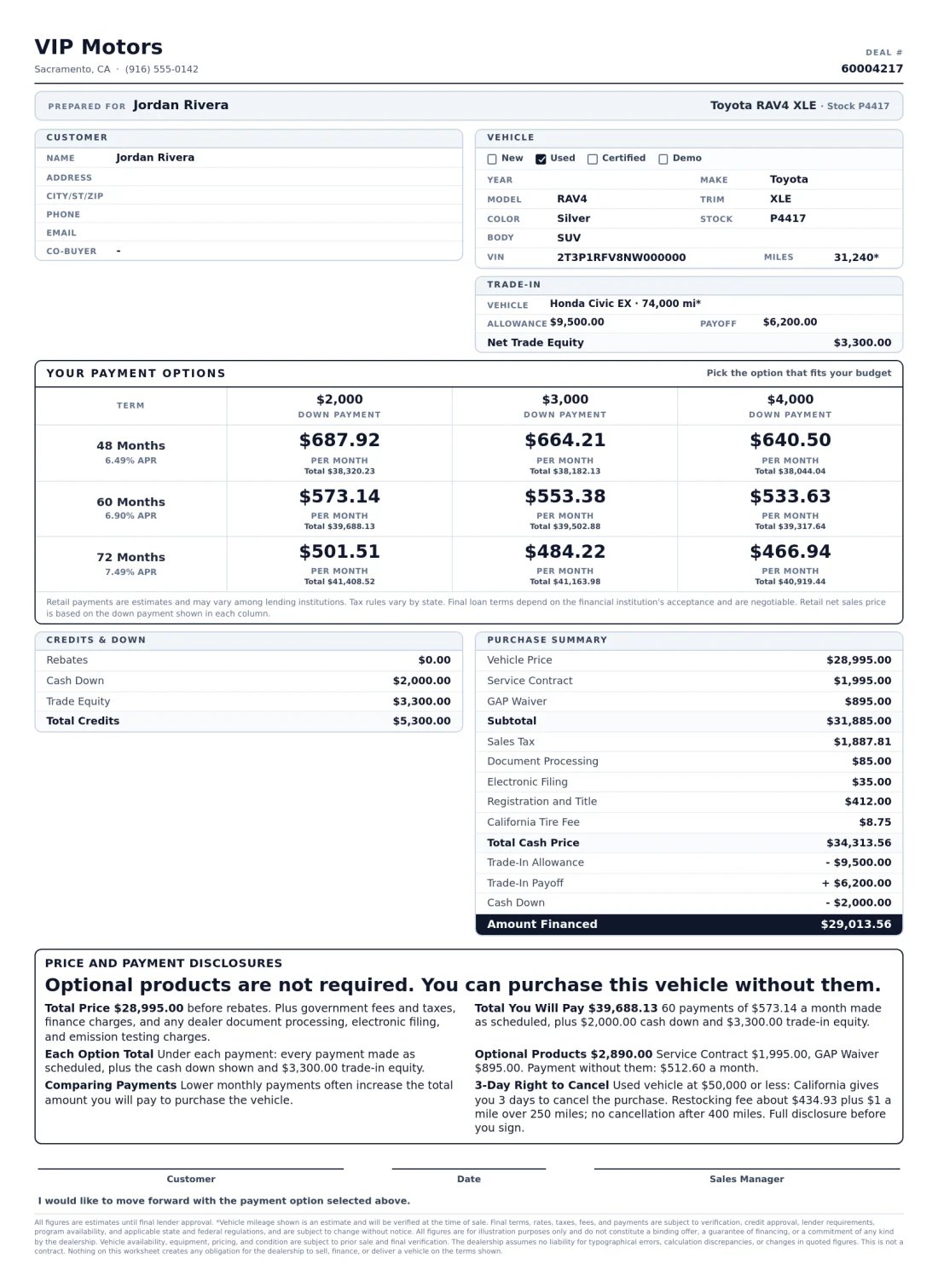
- Total price on every customer sheet
- A total under every payment shown
- Optional products marked not required
- A Spanish page with one switch

What is the California CARS Act?
The California Combating Auto Retail Scams Act, passed as SB 766, adds a full chapter to the Civil Code (Sections 1784.20 through 1784.44) and updates the Vehicle Code sign and contract rules that go with it. It is now in force for every licensed California dealer who sells, leases or finances a vehicle to a consumer, new or used, in the showroom or online.
The Act reaches self propelled vehicles that must be registered. It leaves out wholesale sales, fleet deals of more than one vehicle for business use, buyers who purchase five or more vehicles a year from the store for business use, and vehicles with a gross vehicle weight rating of 10,000 pounds or more. Under the Act's definitions, motorhomes under that weight are covered, while boats and towable trailers are not motor vehicles.
Most of the Act turns on one idea: what a customer reads in writing has to match the deal. That makes it a desking and paperwork law as much as an advertising law, which is exactly where LeadLocate desking does its work.
- New and used vehicles
- Sales, leases and dealer financing
- Showroom and online deals
- Every licensed California dealer
Every CARS Act rule, and the LeadLocate answer
What the law asks for, and what your desk prints for it

Show the total price
Civil Code 1784.41(a)In ads for a specific vehicle and in the first written reply about one, always before rebates.
Total price on every sheet
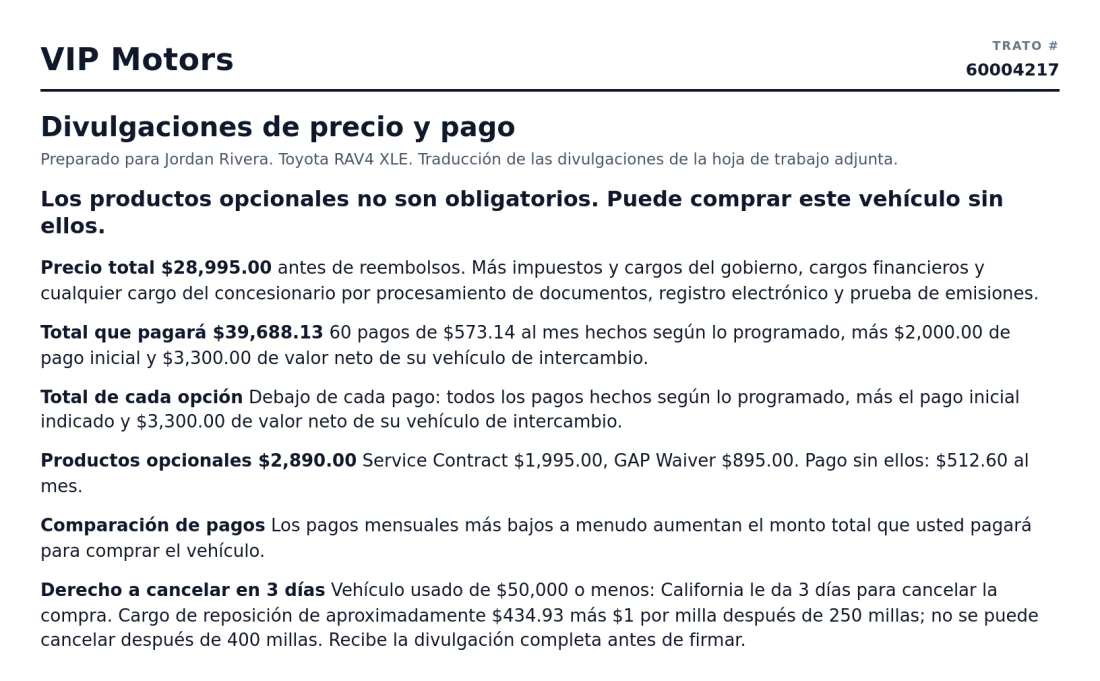
Each Customer View prints the total price before rebates and names exactly what California lets it leave out.
A total at every payment
Civil Code 1784.41(c)Any written payment shows what the customer pays after every scheduled payment, with the cash down and trade-in it assumes.
A total under every payment
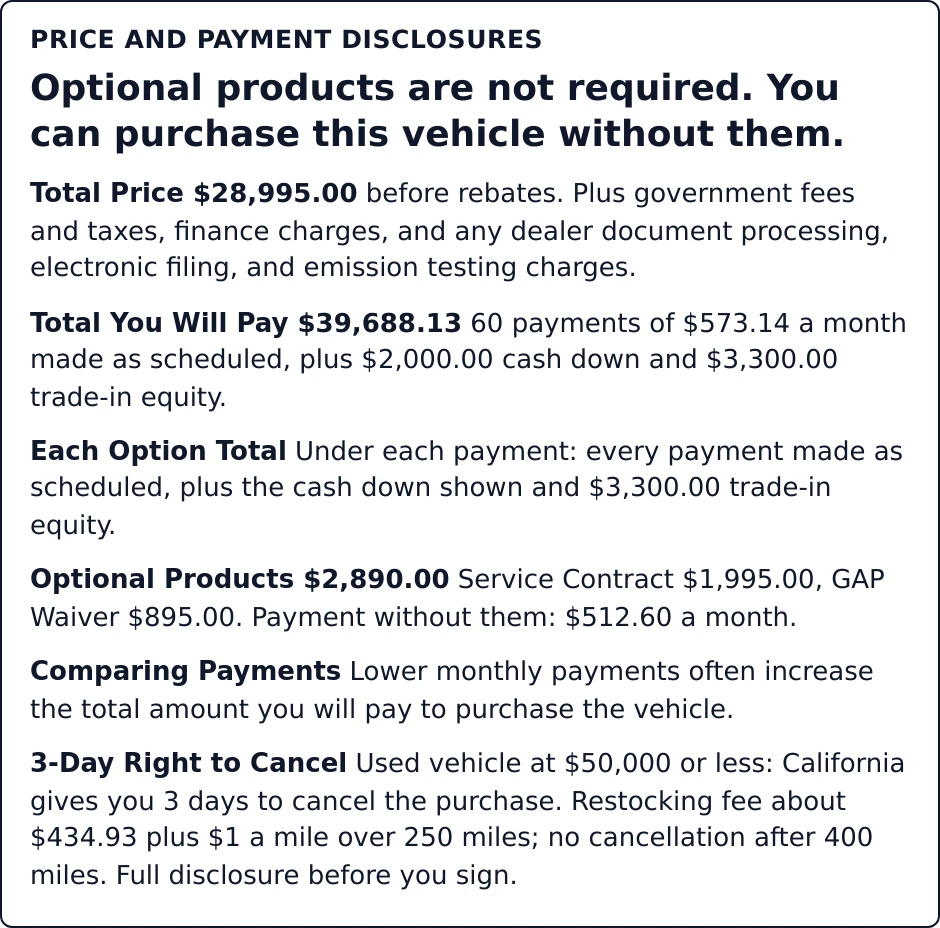
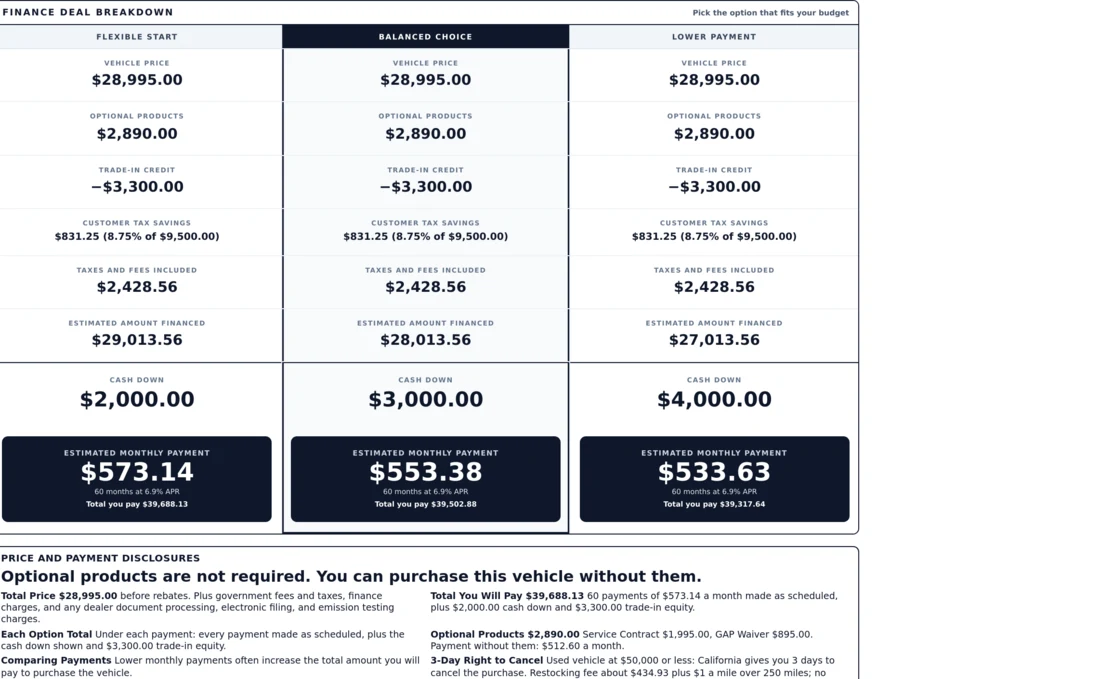
Every payment on the sheet carries its own total, and the disclosure box states the cash down and trade-in equity behind it.
Lower payments often cost more
Civil Code 1784.41(d)Any written comparison of payment options says lower monthly payments often increase the total.
On every comparison sheet
The v1, v3, v4 and v5 Customer Views carry the sentence word for word.
Add-ons are optional
Civil Code 1784.41(b) and DMV guidanceSaid at least once in writing, clearly, and the DMV asks for at least 12 point type.
12 point statement, payment without them
Optional products print by name and price, the not required statement prints in 12 point type, and the payment without them sits beside it.
In the customer's language
Civil Code 1632(b)A deal negotiated primarily in Spanish gets the disclosures in Spanish too.
One switch adds the Spanish page
Spanish Disclosures in the Print menu adds a full page in Spanish to the printed and shared sheet, with a line for the customer to sign.
No add-on without a benefit
Civil Code 1784.42Nitrogen under 95 percent purity, oil changes on an electric vehicle, catalytic marking without a converter and more.
The F&I Desk flags them
California desks see a warning on those products, on a doc fee over $85 and on a finance markup over the state limit.
3-Day Right to Cancel
Civil Code 1784.43Used vehicles at $50,000 or less, with a restocking fee and a 400 mile limit.
Noted with the fee worked out
California sheets note the right on qualifying used vehicles with the restocking fee, and the F&I Desk reminds the desk to hand over the separate disclosure.
Two years of records
Civil Code 1784.44Ads, first replies, signed paperwork, add-on records, cancellations and complaints.
The whole file in one place
Texts, emails and calls stay on the customer's timeline, shared sheets keep their history and signatures, and the Deal Jacket keeps the signed paperwork your team uploads.
What does the total price have to include?

The total price is the full sale price of the vehicle, including any dealer price adjustment and anything already installed on the vehicle, before any rebate. It may leave out only what Vehicle Code 11713.1(e) allows an advertised price to leave out: taxes, registration and other government fees, the California tire fee, finance charges, the dealer document processing charge, the electronic filing charge and an emission testing charge.
The total price has to appear in three places:
- any advertisement that references a specific vehicle for sale;
- any advertisement that shows a monetary amount or financing term for a specific vehicle;
- your first written reply to a customer about a specific vehicle, or about any amount or financing term. The DMV names email, text messages, quotes and credit applications. Keep a copy of that first communication for two years and give it to the customer on written request.
The document processing charge is capped at $85 for dealers in the DMV electronic registration program and $70 for everyone else, and it can never be presented as a government fee.
What must every written payment quote show?
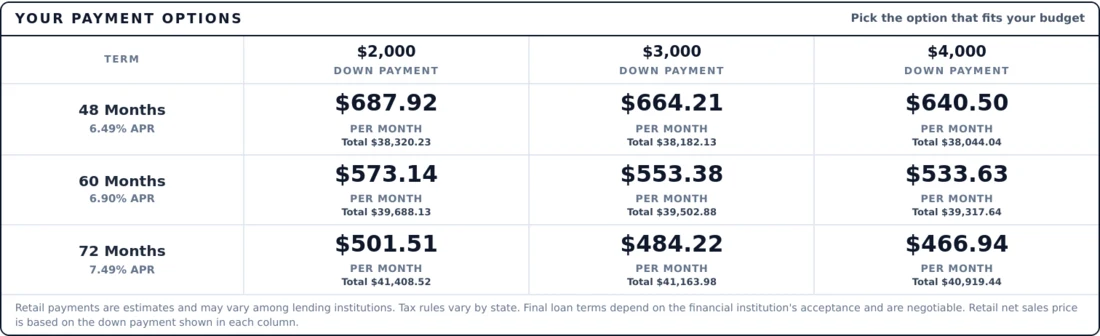
Any time a payment is quoted in writing while a specific vehicle is being negotiated, the dealer has to disclose, at least once and clearly, the total amount the customer will pay at that monthly payment after making every payment as scheduled. If that total assumes a cash down payment or a trade-in, the amount of each has to be stated too.
When the paperwork compares payment options and talks about a lower monthly payment, it has to say that lower monthly payments often increase the total amount the customer will pay. An online payment calculator that lets the customer change the numbers is allowed.
These statements can live in the same document as the optional items disclosure that Civil Code 2982.2 already requires before a finance contract is signed, the one that lists each optional item with its price and shows the payment with and without them.
- Every payment made as scheduled
- Plus the cash down in that column
- Plus the trade-in equity applied
- Lower payments often cost more in total
How do add-on products have to be handled?

Any time an add-on is mentioned in writing during the negotiation, the dealer has to state at least once that it is not required and that the customer can buy or lease the vehicle without it. The DMV asks for that statement both out loud and in writing, in at least 12 point type.
The Act also names add-ons a dealer may not charge for because the customer gets nothing from them:
- nitrogen tire fills under 95 percent purity;
- products that cover nothing for the vehicle, the customer or the deal;
- a GAP agreement that does not meet Civil Code 2982, 2982.2 and 2982.12;
- a service contract that is void because of an existing condition, crash or flood damage;
- oil changes on an electric vehicle;
- catalytic converter marking on a vehicle without one;
- a surface protection product that voids the factory paint warranty.
Service contracts, GAP and protection products the customer chooses and benefits from stay fully sellable. The dealer pays the provider within 10 days of signing unless its agreement with that provider says otherwise without affecting coverage.
- Service contracts
- GAP waivers that meet Civil Code 2982.12
- Tire and wheel protection
- Appearance and theft protection
A California deal, start to finish
Where each CARS Act rule shows up on a normal day
The first reply about a vehicle
Your first text or email about a specific vehicle includes its total price, and LeadLocate keeps that message on the customer's timeline.
MessagingThe worksheet
Print or share any Customer View and the Price and Payment Disclosures box is already on it.
DeskingOptional products
Add-ons print by name and price with the 12 point not required statement and the payment without them.
Customer ViewSpanish when the deal is in Spanish
One switch in the Print menu adds the full Spanish page to the same sheet.
Print menuSigning
On a used vehicle at $50,000 or less, the F&I Desk reminds the desk to hand over the separate 3-Day Right to Cancel disclosure.
F&I DeskThe three days after
If the customer cancels, refund within 48 hours and return the trade-in. Every text and email from those days stays on the timeline.
Customer timeline
Built for California desks
Every rule on this page prints itself on the paperwork your team already uses.
How does the 3-Day Right to Cancel work?

A used vehicle sold or leased at retail for $50,000 or less comes with a free 3-Day Right to Cancel. It replaces the paid two day contract cancellation option. The three calendar days start the day after the contract is signed, run to the close of business, and roll to the next open day if the third day falls on a day the store is closed.
- The right ends once the vehicle has been driven more than 400 miles after signing.
- The dealer may charge a restocking fee of 1.5 percent of the sale price, at least $200 and no more than $600, plus $1 a mile over 250 miles up to $150.
- The dealer cancels the contract and refunds the customer within 48 hours, returns the trade-in and its keys, or pays the greatest of the agreed value, the resale price or fair market value if the trade-in is already sold.
- The customer gets a separate document titled "3-Day Right to Cancel Used Car Purchase or Lease" with the deadline, the restocking fee math, the 400 mile rule and the return conditions.
- The first page of every purchase and lease contract carries the statutory cooling off notice, and every sales office, cubicle and contract room shows the posted notice in at least 36 point type.
New vehicles, motorcycles and used vehicles over $50,000 are outside the 3-Day Right to Cancel. A dealer can always offer a longer or wider return policy.
- 1.5 percent of the sale price, $200 to $600
- Plus $1 a mile over 250 miles, up to $150
- No cancellation after 400 miles
- Refund within 48 hours of cancelling

Questions? Request a Call Back
Leave your number and a lead specialist calls you back to answer your questions about pricing, coverage, and setup. Mon - Sat, 9:00 AM - 6:00 PM Pacific.
Prefer to talk right now? Call or text 844-376-2274.
What can a dealer never misstate?
Section 1784.40 makes a misrepresentation of material information a violation on any of these points:
- the costs or terms of buying, financing or leasing;
- the cost, limits or benefits of an add-on;
- whether the final contract is a sale or a lease, while presenting several payment options stays fine;
- whether a vehicle is available at a total price the dealer communicated, and the remedy when it is not;
- whether a customer is preapproved or guaranteed for anything;
- anything about the customer's credit application;
- whether the dealer keeps a down payment or trade-in, charges fees or takes action if the deal does not go through;
- when the dealer pays off the loan or lease on a trade-in, and what happens if that payoff runs past the 21 days the Vehicle Code allows;
- any connection to a government agency or the military;
- when a vehicle can be repossessed, and whether it can leave California or the United States;
- any disclosure the Act requires.
- Price and terms
- Add-on costs and benefits
- Preapproval claims
- Trade-in payoff timing
What records does a California dealer keep, and for how long?
Section 1784.44 asks for two years of records that show compliance, kept in any legible form, paper or electronic:
- advertisements and online listings that show a total price, features or financing terms, plus the first written communications that carried the total price;
- every signed purchase order, finance and lease document, whether or not the contract was funded, and every written communication about the sale, financing or lease with a customer who signed;
- add-on records: service contracts, GAP agreements, proof of timely payment to providers and the loan to value calculation on every contract with GAP;
- cancellation requests, refund proof and proof the trade-in went back;
- written complaints and written questions about add-ons or advertised vehicles.
Credit documents keep their longer seven year rule under Civil Code 2984.5. In LeadLocate every text, email and call stays on the customer's timeline, every shared deal sheet keeps its link history and signature, and the Deal Jacket keeps the signed paperwork your team uploads, so the file a regulator asks for is already in one place.

Who enforces the CARS Act?
The Act has no penalty schedule of its own, and any waiver a customer signs is void. Enforcement runs through the laws California already uses against dealers: the Unfair Competition Law and the False Advertising Law, with civil penalties of up to $2,500 per violation in actions brought by public prosecutors; the Consumers Legal Remedies Act, which lets customers recover damages, restitution and attorney fees; and DMV license discipline under the Vehicle Code. Each worksheet, text and ad can count on its own, which is why the paperwork itself has to be right every time.
Where enforcement comes from
- Unfair Competition Law
- False Advertising Law
- Consumers Legal Remedies Act
- DMV license discipline
How does LeadLocate put the CARS Act on every deal?
LeadLocate builds the required statements into the documents your team already hands customers, so a salesperson never has to remember the wording. Every Customer View in desking, printed or shared as a Pencil Recap sheet, carries the Price and Payment Disclosures box, and one switch in the Print menu adds the same disclosures on a page in Spanish.
For California stores the F&I Desk flags a doc fee over $85, a finance markup over the Civil Code 2982.10 limit and the add-ons the Act bars, and it reminds the desk to hand over the 3-Day Right to Cancel disclosure. Credit applications run through SecureWebX with each store's own state disclosures and privacy notice.
California rules switch on whenever the store or the customer is in California, so a store in another state selling to a California buyer prints them too. The Dealer View adds a page with the same disclosures and a compliance checklist for the desk, and the customer's online deal page shows the price and payment disclosures beside the deal summary.
Hand California customers paperwork you are proud of
Sign up online and every customer sheet your team prints or shares carries the CARS Act disclosures from the first deal.
- Month to month, no long term contract
- Desking, texting, calls and credit applications in one login
- Training and support from the first day
Prefer to talk first? Call or text 844-376-2274.
Frequently Asked Questions
Does the CARS Act apply to new vehicles?
Yes. The total price, payment total, add-on and misrepresentation rules apply to new and used vehicles, sold, leased or financed. Only the 3-Day Right to Cancel is limited to used vehicles at $50,000 or less.
Can my store still sell service contracts and GAP?
Yes. Any add-on the customer chooses and benefits from stays sellable. Say in writing that it is optional, show the payment without it, keep GAP within Civil Code 2982.12 and its loan to value calculation on file, and pay the provider within 10 days.
Is the doc fee part of the total price?
No. The dealer document processing charge and the electronic filing charge may be left out of the total price, along with taxes and government fees, as long as the price says they are extra. The doc fee itself is capped at $85 for DMV electronic registration partners and $70 for other dealers.
When do the disclosures have to be in Spanish?
When the deal is negotiated primarily in Spanish, Chinese, Tagalog, Vietnamese or Korean, the add-on and payment disclosures and the 3-Day Right to Cancel document also go out in that language. In LeadLocate the Spanish Disclosures switch in the Print menu adds the Spanish page to the printed and shared sheet.
How long does a California dealer keep CARS Act records?
Two years from the day each record is created, in any legible form. Credit documents keep the longer seven year rule of Civil Code 2984.5.
Does the Act cover RVs and boats?
Self propelled motorhomes under 10,000 pounds gross vehicle weight rating are covered. Motorhomes at or above that weight, towable trailers and boats fall outside the Act's definition of a motor vehicle.
Does a store outside California need this for California buyers?
A store in another state that sells to a California buyer should follow the same disclosures. In LeadLocate the California wording, the 3-Day Right to Cancel note and the F&I Desk limits switch on whenever the customer's address is in California, whatever state the store is in.
Put every California deal on solid ground
LeadLocate prints the CARS Act disclosures on every customer sheet your team hands out. Sign up online or call 844-376-2274 for a walkthrough.
Prefer to talk right now? Call or text 844-376-2274.


LeadLocate™ All rights reserved. Other product and company names mentioned herein are the property of their respective owners.
Answers to your questions:
LeadLocate is an all-in-one lead generation software and CRM platform. We generate in-market sales leads and provide you with all the tools necessary to sell that customer. All of your leads, texts, calls, emails, deals, and files are available in one place, accessible with a single login.

LeadLocate™ All rights reserved. Other product and company names mentioned herein are the property of their respective owners.
Answers to your questions:
LeadLocate is an all-in-one lead generation software and CRM platform. We generate in-market sales leads and provide you with all the tools necessary to sell that customer. All of your leads, texts, calls, emails, deals, and files are available in one place, accessible with a single login.